
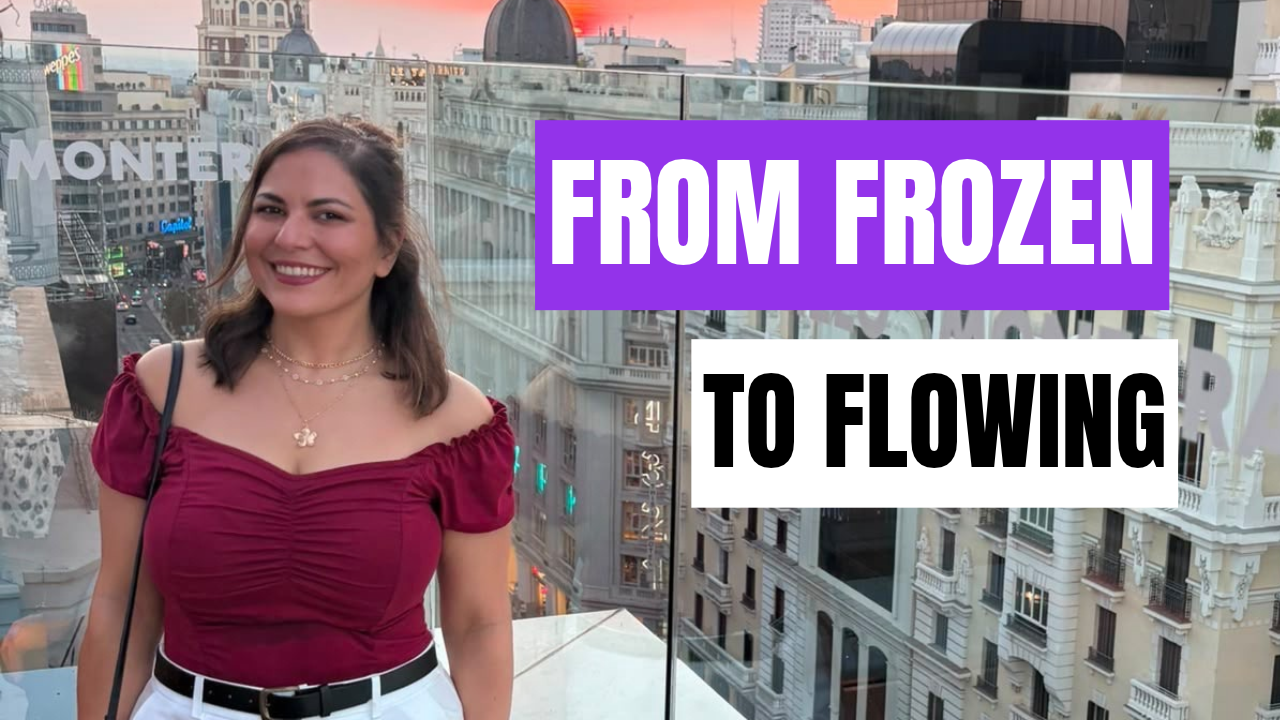
She had a 700-day streak on Duolingo.
She had recently moved to Spain, which meant endless chances to practice: watching the shows, listening to the music, ordering food, navigating public transportation, chatting with waiters. The basics? Down.
And yet, when it came to a real conversation with her Spanish-speaking colleagues or neighbors, she froze.
She had the vocabulary. She had the grammar. So why did she still freeze, and what actually got her unstuck?
That’s the story I want to tell you, because I lived it from the other side. Nadine is my client. She’s also my sister. And her story might be closer to yours than you think.
Childhood & School Experience
Nadine and I grew up the same way: our parents spoke Spanish and Arabic to us when we were little, and certain words and phrases from both languages still live in how we talk. But growing up first-generation in the US is a complicated thing. The language was there, and so were the cultural pressures that make you quietly set it down.
We both took Spanish in school. Nadine actually went further than I did. I made it to Spanish 3; she went all the way to Spanish 5, took AP Spanish 4 and 5, and AP’d out of Spanish in college.
Here’s how she remembers those classes:
“I love the Spanish classes in high school because we not only learned the language, but we were immersed with the food and the culture. And then especially in Spanish 5, we were going through all Spanish literature, including poetry.”
But when I asked what she’d change about all those years of classes, her answer came instantly:
“One thing I could say that would be better was to practice speaking.”
All that reading, all that grammar, all those years, and speaking was never really part of it.
The back burner
College came, and the language went into storage.
“I only took one class in college and it was pretty basic level Spanish, so I just flew by there, got an easy A. And then after that I didn’t really have a means to speak it at my job.”
There was something else underneath that, too, and it matters:
“Growing up I tried to speak Spanish with my cousins and I felt like that wasn’t well received. I would get made fun of for my accent, so that kind of pushed me away from speaking.”
Read that again. A kid with years of Spanish, a bilingual household, top-level high school classes, and one round of teasing about her accent was enough to push speaking off the table. If you’ve ever hesitated to open your mouth in Spanish because of how you might sound, you know exactly how that works. The freeze doesn’t start the day you can’t find a word. Often it starts years earlier, in a moment like that.
Spain, and the streak that lied
Then Nadine got a job opportunity in Spain, and she took it. Renewed motivation, renewed goal. So she did what almost everyone does: she downloaded Duolingo, watched shows in Spanish, practiced with waiters and on public transit.
For a while, it looked like progress.
“I had a huge streak on Duolingo and I thought, oh, I’m doing my little games and goals for the day. I should be progressing after two years of doing this. And while I could get 90% of the games correct on Duolingo, I still was struggling in everyday life to speak and express myself the way I wanted to.”
Picture that. Two years of daily streaks. 90% accuracy. And in a real conversation, still stuck.
“Duolingo doesn’t really provide that speaking part. It’s also very broad, so you’re not really learning phrases you can use in everyday life. The key to speaking for me has been learning and memorizing certain phrases to use in certain contexts.”
Then came the moment every learner dreads.
“You don’t know enough Spanish to hang out with me and my friends”
One day, Nadine wanted to join her colleague and her colleague’s friends, all Spanish speakers. And her colleague told her, bluntly:
“You don’t know enough Spanish to hang out with me and my friends.”
I’m guessing something in you just clenched. That’s the blow nobody sees coming, because you were feeling confident. You were thinking, I’m actually getting better at this. And then someone holds up a mirror and it doesn’t match what you thought you’d see.
Nadine puts it simply: it’s a horrible feeling, and she doesn’t wish it on anybody.
She could still handle the very basics. “I can order at a restaurant easily,” she says. But the deeper conversations, expressing feelings, describing her work, that’s where she kept hitting the wall. And a friendship app event she joined after moving made it painfully concrete: everyone was speaking Spanish, she was introducing herself to a group, and the words for her own life weren’t there.
“Describing my work is very specialized Spanish to the healthcare industry. When I couldn’t do a basic task like introducing myself, explaining what I do, what I like, my hobbies, I felt like I really needed to seek out help in order to speak well.”
She was venting to me about it when I told her: look, I want to help you with this. I’m a Spanish coach, Duolingo is okay, but there’s so much more you could do. Let’s work this out together, because I know exactly what you’re going through. I studied abroad in Spain and lived there as an adult teaching English. I’ve been on that side of the freeze.
We worked together for six months. And what we found was that the thing keeping her stuck wasn’t vocabulary. It wasn’t grammar. It was something beyond both.
What was actually holding her back
The accent story. One of the first things we untangled was the voice in her head judging her accent, the same voice that got planted by her cousins years ago. Yes, we did pronunciation work; there were a few vowels to iron out. But the real shift was the reframe: you’re going to have an accent, it’s natural, it’s part of who you are, and it isn’t something bad about you. You don’t have to sound like a native speaker. You can sound like yourself in Spanish and be understood in Spanish, accent and all. An accent isn’t a flaw. It’s the badge that you’re bilingual.
The freeze itself. We went through her real day-to-day language moments, the exact moments she froze, and analyzed them together. Then I gave her practical tools for going blank: gestures, describing around the word you can’t find, pausing on purpose instead of panicking about pausing, natural ways native speakers buy time in Spanish, ways to ask questions so she never had to feel incompetent mid-conversation. We found easy patterns to recognize during conversations, so speaking stopped being a pop quiz where she had to run all the logic in her head, and became something she could ride.
The practice routine. No more mindless tapping or passive listening. We switched to active recall that trains your brain to pull words up faster and faster, which is exactly what happens in a conversation. As Nadine puts it:
“You can memorize and practice all you want, but what matters is what happens in the moment when you’re speaking to somebody.”
We also killed the anxiety around studying. The old routine felt like homework; the new one fit into her day, low stress, built around her interests.
Practicing the conversations she actually has. One of the biggest wins surprised her:
“Describing things in the past with pretérito y imperfecto really helped me and my confidence. That led to my confidence just diving into those conversations with people.”
Of course it did. When you talk to someone, you’re usually telling them about your past experiences and stories. That’s how people relate to each other. So that’s what we practiced.
Here’s how Nadine sums up the whole six months:
“It has given me the tools to use in everyday life here, and focused on things and words I can actually use, rather than just going over grammar.”
From frozen to flowing
So where is Nadine now?
“My confidence when we started was definitely out of one, and now it’s probably like a five or six.”
You might hear “five or six” and think that doesn’t sound like much. But listen to what that number means in real life:
“Even if I don’t know a word or phrase in English or in Spanish, I’m still confident to go up to someone and just start speaking Spanish, even if I’m not gonna know exactly what to say. Because I found that if you start speaking in Spanish and you at least try, it’s usually reciprocated.”
That’s the difference. Not perfect Spanish. Not a finished streak. A person who walks up and starts, knowing she’ll find her way through. Over those six months we healed years of speaking anxiety, imposter syndrome, and the fear of making a mistake, and she finally started flowing.
Want to hear the whole story from both of us? Watch the video:
If Nadine’s story is your story
Most people think learning Spanish is unattainable, but I’d argue they’ve just been guided the wrong way: generic advice like “watch more stuff in Spanish,” “just immerse yourself,” “practice more,” plus the stories they believe about themselves. We’ve all heard those lines. My brain doesn’t work that way. I don’t have time. I can understand more than I can speak.
And other people look for the easy way out: tap an app, or sit at a desk and study. But the truth is that anyone who wants to learn is capable of learning. It is attainable. You need the right guidance, and you need to work on what’s actually keeping you stuck, which for most frozen speakers is not the vocabulary or the grammar.
Nadine had 700 days of proof that the app alone wouldn’t get her there. What got her there was reframing the stories in her head, learning practical skills for the freeze moments so she could talk through the hesitation and walk away with less self-doubt, and building a practice routine that was fun, low-stress, and woven into her real life.
That combination is what I built my 12-week course around, inspired by Nadine and every client who’s been stuck in exactly the same place. If you’re ready to stop freezing and start flowing in Spanish, you can find all the details for the upcoming course here.